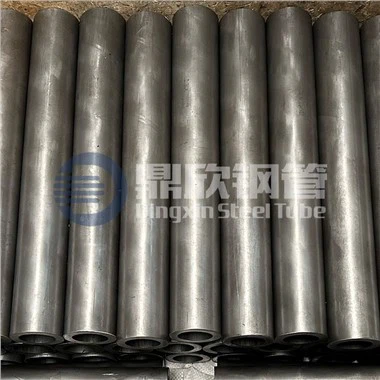
As a trusted supplier of ASTM A519 seamless mechanical tubing, I've encountered numerous inquiries regarding the post - welding heat treatment requirements for this material. In this blog, I'll delve into the details of these requirements, explaining why they are crucial and how they can impact the performance of the welded components.
Understanding ASTM A519
ASTM A519 is a standard specification for seamless carbon and alloy steel mechanical tubing. This type of tubing is widely used in various mechanical applications, such as automotive, machinery, and aerospace industries, due to its excellent mechanical properties, including high strength, good ductility, and resistance to wear.
Why Post - Welding Heat Treatment?
Welding is a process that involves heating and cooling the metal, which can cause significant changes in the material's microstructure. These changes can lead to residual stresses, hardness variations, and potential cracking in the welded area. Post - welding heat treatment (PWHT) is a crucial step to mitigate these issues and restore the material's original properties or achieve the desired properties for the specific application.
General Post - Welding Heat Treatment Requirements for ASTM A519
Stress Relieving
Stress relieving is one of the most common post - welding heat treatment processes for ASTM A519 tubing. During welding, the rapid heating and cooling cycles generate residual stresses in the welded joint and the surrounding base metal. These residual stresses can reduce the fatigue life of the component and increase the risk of stress - corrosion cracking.
The stress - relieving process typically involves heating the welded component to a specific temperature range, holding it at that temperature for a certain period, and then slowly cooling it down. For ASTM A519 tubing, the stress - relieving temperature usually ranges from 550°C to 650°C (1022°F to 1202°F), depending on the specific alloy composition and wall thickness of the tubing.
The holding time at the stress - relieving temperature is determined by the thickness of the welded section. As a general rule, for every 25 mm (1 inch) of thickness, a holding time of 1 hour is recommended. However, this can vary based on the specific requirements of the application and the material specifications.
Normalizing
Normalizing is another post - welding heat treatment option for ASTM A519. This process involves heating the welded component above the upper critical temperature, holding it for a sufficient time to allow complete austenitization, and then air - cooling it. Normalizing helps to refine the grain structure of the material, improve its mechanical properties, and reduce the residual stresses.
The normalizing temperature for ASTM A519 tubing typically ranges from 850°C to 950°C (1562°F to 1742°F). The holding time at the normalizing temperature depends on the thickness of the component and the specific alloy composition. After normalizing, the material will have a more uniform microstructure and better mechanical properties compared to the as - welded condition.
Annealing
Annealing is a heat treatment process that involves heating the material to a specific temperature, holding it for a long time, and then slowly cooling it to room temperature. This process is used to soften the material, relieve residual stresses, and improve its machinability.
For ASTM A519 tubing, annealing can be performed at a temperature range of 700°C to 800°C (1292°F to 1472°F). The holding time at the annealing temperature is usually longer than that for stress relieving or normalizing, typically several hours, depending on the thickness of the component.
Factors Affecting Post - Welding Heat Treatment Requirements
Alloy Composition
The alloy composition of ASTM A519 tubing plays a significant role in determining the post - welding heat treatment requirements. Different alloying elements, such as carbon, manganese, chromium, and nickel, can affect the material's hardenability, phase transformation temperatures, and response to heat treatment. For example, tubing with a higher carbon content may require more careful heat treatment to avoid excessive hardness and cracking in the welded area.
Wall Thickness
The wall thickness of the ASTM A519 tubing also affects the post - welding heat treatment process. Thicker - walled tubing requires longer heating and holding times to ensure uniform temperature distribution throughout the cross - section. Additionally, thicker sections may be more prone to residual stress buildup during welding, which may require more aggressive post - welding heat treatment to relieve these stresses.
Welding Process
The welding process used for joining ASTM A519 tubing can also influence the post - welding heat treatment requirements. Different welding processes, such as TIG (Tungsten Inert Gas), MIG (Metal Inert Gas), and SMAW (Shielded Metal Arc Welding), generate different heat inputs and cooling rates, which can result in different microstructures and residual stress distributions in the welded joint.
Specific Considerations for Different Applications
Automotive Industry
In the automotive industry, ASTM A519 tubing is commonly used in components such as drive shafts, axles, and suspension systems. These components are subjected to high dynamic loads and cyclic stresses, so the post - welding heat treatment is crucial to ensure their fatigue resistance and reliability. Stress relieving or normalizing is often recommended to reduce residual stresses and improve the material's mechanical properties.
Machinery Industry
In the machinery industry, ASTM A519 tubing is used in various machine parts, such as shafts, gears, and connecting rods. The post - welding heat treatment requirements depend on the specific application and the operating conditions of the machinery. For example, components that require high hardness and wear resistance may undergo quenching and tempering after welding, while those that need to be more ductile may be stress - relieved or annealed.
Related Products
If you are interested in other types of seamless tubes, we also offer a wide range of products, including EN 10305 - 1 E215 E235 E355 +C+SR+A+N Cold Drawn Seamless Tube, DIN 17200 C22/Ck22 C25/Ck25 C30/Ck30 C35/Ck35 C45/Ck45 C55/Ck55 Seamless Tube, and Cold Drawn Seamless Tube 20Cr 40Cr. These products are also suitable for various mechanical applications and can be customized according to your specific requirements.
Conclusion
Post - welding heat treatment is an essential step in ensuring the quality and performance of welded ASTM A519 tubing. By understanding the general requirements and the factors that affect the post - welding heat treatment process, you can make informed decisions to optimize the properties of your welded components.
If you are in need of ASTM A519 tubing or have any questions about post - welding heat treatment, please feel free to contact us for further discussion and procurement. We are committed to providing high - quality products and professional technical support to meet your specific needs.


References
- ASTM International. ASTM A519/A519M - 21 Standard Specification for Seamless Carbon and Alloy Steel Mechanical Tubing.
- ASM Handbook Volume 4: Heat Treating. ASM International.
- Welding Handbook, Volume 2: Welding Processes. American Welding Society.