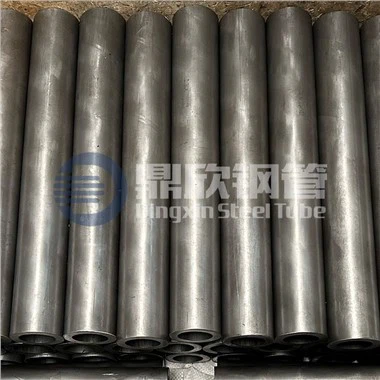
When it comes to the oil and gas industry, casing tubes play a crucial role in ensuring the integrity and efficiency of well operations. As a dedicated casing tube supplier, I've witnessed firsthand the diverse requirements and applications of different casing tube grades. In this blog, we'll delve into the mechanical properties of various casing tube grades, exploring what makes each one unique and suitable for specific scenarios.
Understanding Casing Tubes
Casing tubes are essentially large-diameter pipes that are inserted into a wellbore to provide structural support, prevent wellbore collapse, and isolate different geological formations. They are subjected to a variety of forces, including internal and external pressure, axial loads, and bending stresses. Therefore, the mechanical properties of casing tubes are of utmost importance to ensure their performance and durability in harsh downhole environments.


Common Casing Tube Grades and Their Mechanical Properties
J55 Casing Pipe
J55 is one of the most commonly used casing tube grades, known for its relatively low cost and good mechanical properties. It has a minimum yield strength of 55,000 psi (379 MPa) and a minimum tensile strength of 75,000 psi (517 MPa). The J55 grade offers a good balance between strength and ductility, making it suitable for a wide range of applications, especially in shallow wells or areas with relatively low pressure and stress conditions. For more information on J55 and other related casing pipes, you can visit our N80 J55 K55 Casing Pipe page.
K55 Casing Pipe
K55 is an upgraded version of J55, with slightly higher mechanical properties. It has a minimum yield strength of 55,000 psi (379 MPa) and a minimum tensile strength of 75,000 - 95,000 psi (517 - 655 MPa). The K55 grade provides better resistance to deformation and failure under higher loads compared to J55, making it suitable for deeper wells or areas with more challenging geological conditions.
N80 Casing Pipe
N80 is a high-strength casing tube grade widely used in the oil and gas industry. It has a minimum yield strength of 80,000 psi (552 MPa) and a minimum tensile strength of 95,000 psi (655 MPa). The N80 grade offers excellent mechanical properties, including high strength, good toughness, and resistance to corrosion. It is commonly used in medium to deep wells, where higher pressure and stress conditions are encountered. Our N80 J55 K55 Casing Pipe page provides detailed information on the N80 grade and its applications.
P110 Casing Pipe
P110 is a premium casing tube grade with the highest mechanical properties among the commonly used grades. It has a minimum yield strength of 110,000 psi (758 MPa) and a minimum tensile strength of 125,000 psi (862 MPa). The P110 grade offers exceptional strength and resistance to deformation, making it suitable for ultra-deep wells or areas with extremely high pressure and stress conditions. However, due to its high strength, P110 casing tubes are more expensive and require more careful handling and installation.
Other Specialty Grades
In addition to the above common grades, there are also specialty casing tube grades designed for specific applications. For example, the NW HW PW Drill Casing Pipe 4130 1541 30CrMo 40Mn2 N80 R780 J55 is a series of casing pipes made from different alloy steels, offering unique mechanical properties such as high hardness, wear resistance, and corrosion resistance. These specialty grades are often used in mining, drilling, and other industries where specific performance requirements are needed.
Factors Affecting Mechanical Properties
The mechanical properties of casing tubes are influenced by several factors, including the chemical composition, manufacturing process, and heat treatment.
Chemical Composition
The chemical composition of the steel used to manufacture casing tubes plays a significant role in determining its mechanical properties. For example, the addition of alloying elements such as chromium, molybdenum, and nickel can improve the strength, toughness, and corrosion resistance of the steel. Different grades of casing tubes have different chemical compositions to meet specific performance requirements.
Manufacturing Process
The manufacturing process of casing tubes also affects their mechanical properties. Common manufacturing methods include seamless and welded processes. Seamless casing tubes are generally considered to have better mechanical properties due to their uniform structure and absence of weld seams. Welded casing tubes, on the other hand, are more cost-effective and can be produced in larger diameters.
Heat Treatment
Heat treatment is an important step in the manufacturing of casing tubes to improve their mechanical properties. Processes such as quenching and tempering can increase the strength and hardness of the steel, while annealing can improve its ductility and toughness. The specific heat treatment process used depends on the grade of the casing tube and the desired mechanical properties.
Importance of Selecting the Right Casing Tube Grade
Selecting the right casing tube grade is crucial for the success of well operations. Using a casing tube with insufficient mechanical properties can lead to wellbore collapse, casing failure, and other serious problems, which can result in significant economic losses and environmental risks. On the other hand, using a casing tube with excessive mechanical properties can increase the cost of the project without providing additional benefits.
As a casing tube supplier, we understand the importance of selecting the right grade for each application. Our team of experts can provide technical support and guidance to help you choose the most suitable casing tube grade based on your specific requirements, well conditions, and budget.
Contact Us for Your Casing Tube Needs
If you're in the market for high-quality casing tubes, we'd love to hear from you. Whether you need standard grades like J55, N80, or specialty grades for specific applications, we have a wide range of products to meet your needs. Our commitment to quality, reliability, and customer service ensures that you'll receive the best casing tubes and support for your projects. Contact us today to start a discussion about your casing tube requirements and let's work together to find the perfect solution for your well operations.
References
- API Specification 5CT, Specification for Casing and Tubing, American Petroleum Institute.
- ASME Boiler and Pressure Vessel Code, Section VIII, Division 1, Rules for Construction of Pressure Vessels, American Society of Mechanical Engineers.
- Various technical literature and research papers on casing tube materials and mechanical properties.