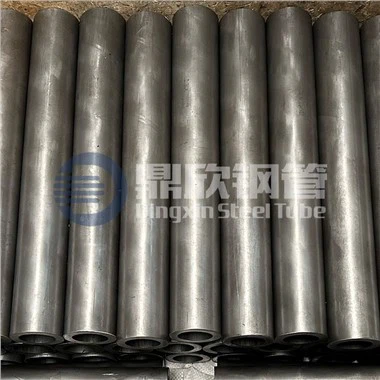
As a supplier of ST35 NBK products, I often encounter inquiries about various aspects of these materials. One question that has been coming up more frequently lately is: "What is the carbon equivalent of ST35 NBK?" In this blog post, I'll delve into this topic, providing a comprehensive understanding of the carbon equivalent of ST35 NBK and its implications.
Understanding ST35 NBK
Before we dive into the carbon equivalent, let's briefly understand what ST35 NBK is. ST35 NBK is a type of precision seamless tube. It falls under the DIN 2391 standard, which specifies the technical delivery conditions for cold - drawn welded and seamless tubes for precision applications. The "NBK" in ST35 NBK stands for normalized in a controlled atmosphere after cold - drawing, which gives the tube certain mechanical properties and a fine - grained structure.
These tubes have a wide range of applications. They are commonly used in automotive manufacturing, for example, in the production of components like Cold Drawn Seamless Tube Q345B Q345D Q355B Q355D. They are also used in the motorcycle industry, such as in the manufacturing of Motorcycle Front Fork Tube SAE 1536 1541. You can find more detailed information about DIN 2391 ST35 ST45 ST52 BK BKW BKS GBK NBK Precision Seamless Tube on our website DIN 2391 ST35 ST45 ST52 BK BKW BKS GBK NBK Precision Seamless Tube.
What is Carbon Equivalent?
Carbon equivalent is a concept used in metallurgy to predict the weldability and hardenability of steel. Since carbon is the most influential element in steel when it comes to these properties, but other alloying elements also have an impact, the carbon equivalent combines the effects of multiple elements into a single value. Different formulas are used to calculate the carbon equivalent, depending on the type of steel and the application.
The most common formula for calculating the carbon equivalent (CE) is the International Institute of Welding (IIW) formula:
[CE = C+\frac{Mn}{6}+\frac{Cr + Mo+V}{5}+\frac{Ni + Cu}{15}]
where C, Mn, Cr, Mo, V, Ni, and Cu are the mass percentages of carbon, manganese, chromium, molybdenum, vanadium, nickel, and copper respectively in the steel.
Carbon Equivalent of ST35 NBK
The chemical composition of ST35 NBK typically includes carbon (C), manganese (Mn), silicon (Si), sulfur (S), and phosphorus (P). The carbon content in ST35 is usually in the range of 0.12 - 0.20%. Manganese content is around 0.30 - 0.60%. Other elements are present in relatively small amounts.
Using the IIW formula to calculate the carbon equivalent of ST35 NBK, we assume the following typical values:
Let's assume (C = 0.15%), (Mn=0.45%), and for simplicity, assume the content of other alloying elements ((Cr, Mo, V, Ni, Cu)) is negligible.
[CE = 0.15+\frac{0.45}{6}]
[CE = 0.15 + 0.075=0.225]
Significance of Carbon Equivalent in ST35 NBK
Weldability
A lower carbon equivalent generally indicates better weldability. For ST35 NBK, with a carbon equivalent of around 0.225, it has relatively good weldability. During the welding process, a lower carbon equivalent reduces the risk of forming hard and brittle martensite in the heat - affected zone (HAZ). Martensite can lead to cracking in the weld and the HAZ, which can compromise the integrity of the welded joint. So, when using ST35 NBK in applications where welding is required, the relatively low carbon equivalent is an advantage.
Hardenability
Hardenability refers to the ability of steel to form martensite under a given cooling rate. A higher carbon equivalent usually means higher hardenability. In the case of ST35 NBK, the carbon equivalent value suggests that it has a moderate hardenability. This is important in applications where the material needs to be heat - treated to achieve certain mechanical properties. For example, if the tube needs to be quenched and tempered to increase its strength, the carbon equivalent helps in determining the appropriate heat - treatment parameters.
Factors Affecting Carbon Equivalent and Its Impact on ST35 NBK
Chemical Composition Variations
The actual carbon equivalent of ST35 NBK can vary depending on the specific chemical composition of the batch. Small variations in the carbon or manganese content can lead to changes in the carbon equivalent value. For example, if the carbon content is at the upper end of the range (0.20%), the carbon equivalent will be higher, which may slightly reduce the weldability and increase the hardenability.


Manufacturing Process
The manufacturing process of ST35 NBK, especially the normalizing process (the "NBK" treatment), can also have an impact on the material's properties related to the carbon equivalent. Normalizing in a controlled atmosphere can refine the grain structure of the steel. A finer grain structure can improve the toughness and ductility of the material, which can offset some of the negative effects of a slightly higher carbon equivalent, such as reducing the risk of cracking during welding.
Applications and the Role of Carbon Equivalent
In automotive applications, where ST35 NBK is used for components like cold - drawn seamless tubes, the carbon equivalent plays a crucial role. These components often need to be welded together to form the final product. The good weldability due to the relatively low carbon equivalent ensures that the welded joints are strong and reliable.
In the motorcycle industry, for front fork tubes, the moderate hardenability associated with the carbon equivalent of ST35 NBK allows for proper heat - treatment to achieve the required strength and toughness. The tubes need to withstand the dynamic loads during motorcycle operation, and the appropriate carbon equivalent helps in achieving the right balance of properties.
Conclusion
In conclusion, the carbon equivalent of ST35 NBK is an important parameter that affects its weldability and hardenability. With a typical carbon equivalent value of around 0.225, ST35 NBK offers a good balance of properties for a wide range of applications, especially in the automotive and motorcycle industries.
If you are interested in purchasing ST35 NBK products or have further questions about their carbon equivalent and other properties, please feel free to contact us for more information and to start a procurement discussion. We are committed to providing high - quality ST35 NBK products that meet your specific requirements.
References
- "Metallurgy of Welding" by John C. Lippold and David J. Kotecki
- DIN 2391 standard documentation
- Technical data sheets of ST35 NBK tubes from steel manufacturers