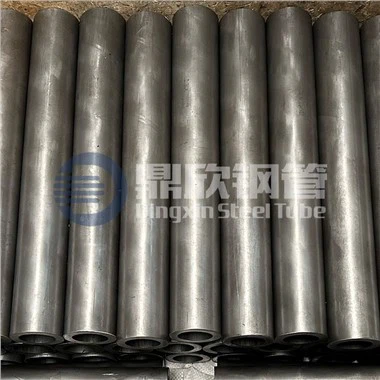
As a reliable supplier of ST35 NBK products, I've often encountered inquiries regarding the Poisson's ratio of ST35 NBK. This mechanical property is crucial for understanding how this material behaves under stress, which is essential for engineers, designers, and anyone involved in applications where ST35 NBK is used.
Understanding Poisson's Ratio
Poisson's ratio, denoted by the Greek letter ν (nu), is a measure of the Poisson effect, the phenomenon in which a material tends to expand in directions perpendicular to the direction of compression. In simpler terms, when you pull on a rubber band, it gets thinner in the middle as it stretches. Poisson's ratio quantifies this relationship between the transverse (lateral) strain and the axial (longitudinal) strain.
Mathematically, Poisson's ratio is defined as the negative ratio of the transverse strain (ε_transverse) to the axial strain (ε_axial) when the material is under uniaxial stress:
ν = - ε_transverse / ε_axial
The value of Poisson's ratio ranges from -1 to 0.5 for most engineering materials. A value of 0.5 indicates an incompressible material, like rubber, where the volume remains constant during deformation. A value close to 0 implies that the material hardly contracts laterally when stretched or compressed axially.
Poisson's Ratio of ST35 NBK
ST35 NBK is a type of carbon steel commonly used in various industrial applications, including automotive components, machinery parts, and structural elements. The Poisson's ratio of ST35 NBK typically falls within the range of 0.28 - 0.30. This value is consistent with most carbon steels, which generally have Poisson's ratios between 0.27 and 0.30.


The specific value of Poisson's ratio for ST35 NBK can be influenced by several factors, including the chemical composition of the steel, its heat treatment history, and the manufacturing process. For example, the presence of alloying elements such as manganese, silicon, and sulfur can slightly affect the material's mechanical properties, including Poisson's ratio. Similarly, heat treatment processes like annealing, quenching, and tempering can alter the microstructure of the steel, leading to changes in its Poisson's ratio.
Importance of Poisson's Ratio in Engineering Applications
Understanding the Poisson's ratio of ST35 NBK is essential for several engineering applications. Here are some examples:
Structural Design
In structural engineering, Poisson's ratio is used to calculate the deformation and stress distribution in structures made of ST35 NBK. For example, when designing a steel beam or column, engineers need to consider how the material will deform under load. The Poisson's ratio affects the lateral expansion or contraction of the beam, which can influence the overall stability and performance of the structure.
Material Testing
Poisson's ratio is also an important parameter in material testing. By measuring the axial and transverse strains of a ST35 NBK specimen under load, engineers can determine its Poisson's ratio. This information is used to validate the material's mechanical properties and ensure that it meets the required specifications for a particular application.
Manufacturing Processes
In manufacturing processes such as machining, forging, and welding, Poisson's ratio plays a role in determining the dimensional accuracy and quality of the final product. For example, when machining a ST35 NBK part, the Poisson's ratio affects the amount of material that is removed during the cutting process. Understanding this relationship can help manufacturers optimize their machining parameters and reduce the risk of dimensional errors.
Our Offerings as an ST35 NBK Supplier
As a leading supplier of ST35 NBK products, we offer a wide range of high-quality seamless tubes and bars made from this material. Our products are manufactured to strict quality standards and undergo rigorous testing to ensure their mechanical properties, including Poisson's ratio, meet the requirements of our customers.
In addition to ST35 NBK, we also supply other types of carbon steels and alloy steels, including DIN 17200 C22/Ck22 C25/Ck25 C30/Ck30 C35/Ck35 C45/Ck45 C55/Ck55 Seamless Tube, Motorcycle Front Fork Tube SAE 1536 1541, and DIN2391 ST52 NBK Seamless Tube. Our extensive product portfolio allows us to meet the diverse needs of our customers in various industries.
Contact Us for ST35 NBK Procurement
If you are interested in purchasing ST35 NBK products or have any questions about Poisson's ratio or other mechanical properties, please feel free to contact us. Our team of experts is available to provide you with detailed information and technical support to help you make the right choice for your application.
We look forward to the opportunity to work with you and provide you with the highest quality ST35 NBK products and services.
References
- Callister, W. D., & Rethwisch, D. G. (2017). Materials Science and Engineering: An Introduction. Wiley.
- Ashby, M. F., & Jones, D. R. H. (2012). Engineering Materials 1: An Introduction to Properties, Applications, and Design. Butterworth-Heinemann.
- Budynas, R. G., & Nisbett, J. K. (2011). Shigley's Mechanical Engineering Design. McGraw-Hill.