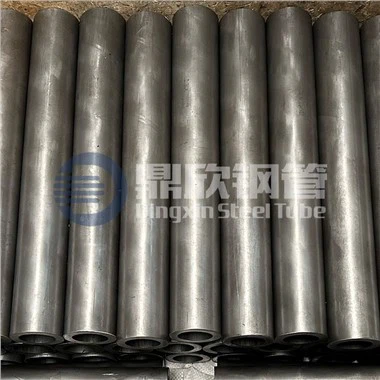
As a supplier of DIN 2391 ST52, I've encountered numerous inquiries regarding the most suitable welding methods for this material. DIN 2391 ST52 is a high - strength low - alloy steel known for its excellent mechanical properties, which makes it a popular choice in various industries such as automotive, construction, and machinery manufacturing. Selecting the right welding method is crucial to ensure the integrity and performance of the welded joints.
1. Understanding DIN 2391 ST52
Before delving into the welding methods, it's essential to understand the characteristics of DIN 2391 ST52. This steel grade typically has a minimum yield strength of around 355 MPa and a tensile strength ranging from 490 - 630 MPa. It contains elements such as carbon, manganese, silicon, and small amounts of other alloying elements, which contribute to its strength and toughness. The chemical composition and mechanical properties of DIN 2391 ST52 influence the welding process and the quality of the resulting welds.


2. Suitable Welding Methods
2.1 Shielded Metal Arc Welding (SMAW)
Shielded Metal Arc Welding, also known as stick welding, is a widely used welding method for DIN 2391 ST52. It is a versatile process that can be used in various environments, including outdoor and field applications. In SMAW, an electrode covered with a flux coating is used. When the electrode is struck against the workpiece, an arc is formed, melting the electrode and the base metal. The flux coating on the electrode decomposes, producing a shielding gas that protects the weld pool from atmospheric contamination.
One of the advantages of SMAW is its simplicity and portability. It doesn't require complex equipment, making it accessible for small - scale operations. However, it has some limitations. The welding speed is relatively slow, and the quality of the welds can be highly dependent on the skill of the welder. For DIN 2391 ST52, it's important to select the appropriate electrode. Electrodes with a matching strength and chemical composition to the base metal, such as E7018, are commonly used. These electrodes provide good mechanical properties and crack resistance in the weld joint.
2.2 Gas Metal Arc Welding (GMAW)
Gas Metal Arc Welding, also known as MIG (Metal Inert Gas) welding, is another popular choice for welding DIN 2391 ST52. In GMAW, a continuous solid wire electrode is fed through a welding gun, and a shielding gas is used to protect the weld pool. The shielding gas can be a mixture of argon and carbon dioxide, which provides good arc stability and weld quality.
GMAW offers several advantages over SMAW. It has a higher welding speed, which can increase productivity in large - scale manufacturing. The welds produced by GMAW are generally smoother and have less spatter compared to SMAW. Additionally, it is easier to automate, making it suitable for mass production. However, GMAW requires more complex equipment and a stable power supply. It is also more sensitive to wind and draft, which can disrupt the shielding gas and lead to weld defects. For DIN 2391 ST52, a solid wire with a composition similar to the base metal, such as ER70S - 6, is often used.
2.3 Gas Tungsten Arc Welding (GTAW)
Gas Tungsten Arc Welding, also known as TIG (Tungsten Inert Gas) welding, is a precise and high - quality welding method for DIN 2391 ST52. In GTAW, a non - consumable tungsten electrode is used to create an arc, and a shielding gas (usually argon) protects the weld area. Filler metal can be added manually if needed.
GTAW is known for producing high - quality welds with excellent appearance and mechanical properties. It allows for precise control of the welding process, making it suitable for thin - walled sections and critical applications. However, it has a relatively low welding speed and requires a high level of skill from the welder. The equipment for GTAW is also more expensive compared to SMAW. For DIN 2391 ST52, a filler metal such as ER70S - 2 can be used to match the base metal properties.
2.4 Submerged Arc Welding (SAW)
Submerged Arc Welding is a high - productivity welding method suitable for thick - walled DIN 2391 ST52 sections. In SAW, an arc is formed between a continuous wire electrode and the workpiece, and the arc is submerged under a layer of granular flux. The flux protects the weld pool from the atmosphere and provides a slag layer that helps in heat insulation and shaping the weld bead.
SAW offers high welding speeds and deep penetration, making it ideal for welding thick plates and pipes. It produces high - quality welds with good mechanical properties and low porosity. However, it is mainly used in automated or semi - automated systems and is not suitable for all welding positions. The equipment for SAW is relatively large and complex, and it requires a proper setup and maintenance. For DIN 2391 ST52, a wire - flux combination that matches the base metal composition should be selected.
3. Considerations for Welding DIN 2391 ST52
Regardless of the welding method chosen, there are several important considerations when welding DIN 2391 ST52.
3.1 Pre - welding Preparation
Proper pre - welding preparation is crucial to ensure the quality of the welds. The surfaces to be welded should be clean and free from rust, oil, and other contaminants. This can be achieved through mechanical cleaning methods such as grinding or wire brushing, followed by chemical cleaning if necessary. Pre - heating may also be required, especially for thick - walled sections or in cold environments. Pre - heating helps to reduce the cooling rate of the weld, minimizing the risk of cracking.
3.2 Welding Parameters
The welding parameters, such as current, voltage, welding speed, and gas flow rate (for gas - shielded welding methods), need to be carefully selected. These parameters depend on the welding method, the thickness of the base metal, and the joint design. Incorrect welding parameters can lead to weld defects such as porosity, lack of fusion, and excessive heat - affected zone.
3.3 Post - welding Treatment
After welding, post - welding treatment may be necessary to improve the mechanical properties of the weld joint. This can include stress - relieving heat treatment, which helps to reduce residual stresses in the weld and the heat - affected zone. Normalizing or tempering may also be performed to enhance the toughness and strength of the weld.
4. Related Products
As a supplier of DIN 2391 ST52, we also offer other related products such as JIS G3444 STK290 STK400 STK500 STK490 STK540 Seamless Carbon Steel Tube, DIN 1630 ST37.4 ST52.4 NBK Seamless Tube, and EN 10305 - 1 E215 E235 E355 +C+SR+A+N Cold Drawn Seamless Tube. These products are widely used in various industries and can be combined with DIN 2391 ST52 in different applications.
5. Conclusion and Invitation
In conclusion, selecting the right welding method for DIN 2391 ST52 is essential to ensure the quality and performance of the welded joints. Shielded Metal Arc Welding, Gas Metal Arc Welding, Gas Tungsten Arc Welding, and Submerged Arc Welding are all suitable methods, each with its own advantages and limitations. By considering the specific requirements of the application, the thickness of the base metal, and the available equipment, the most appropriate welding method can be chosen.
If you are interested in purchasing DIN 2391 ST52 or have any questions regarding welding methods, please feel free to contact us for further discussion and procurement negotiation. We are committed to providing high - quality products and professional technical support to meet your needs.
References
- AWS Welding Handbook, American Welding Society.
- Steel Construction Manual, American Institute of Steel Construction.
- Welding Metallurgy, John C. Lippold and David L. Kotecki.