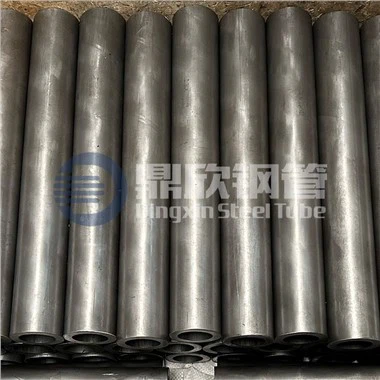
As a trusted supplier of ST35 NBK, I often encounter inquiries regarding the cold - drawing process of this material. Cold - drawing is a metalworking process that involves pulling a metal through a die to reduce its cross - section and improve its surface finish, dimensional accuracy, and mechanical properties. In this blog, I will delve into the question of whether ST35 NBK can be cold - drawn, exploring the characteristics of ST35 NBK, the cold - drawing process, and the factors that influence its cold - drawability.
Understanding ST35 NBK
ST35 NBK is a type of seamless steel tube that is widely used in various industries due to its excellent mechanical properties and good weldability. The "ST" in its name typically stands for "Steel Tube," and the "35" indicates its approximate minimum yield strength in megapascals. The "NBK" denotes a normalized state, which means the material has been heated to a specific temperature and then cooled in air to refine its grain structure and improve its mechanical properties.
This steel tube is commonly used in automotive applications, machinery manufacturing, and construction. Its seamless nature provides a smooth internal and external surface, which is beneficial for applications where fluid flow or low friction is required.
The Cold - Drawing Process
Cold - drawing is a complex process that offers several advantages over other metalworking methods. During cold - drawing, the metal tube is pulled through a die at room temperature. As the tube passes through the die, its diameter and wall thickness are reduced, and its length is increased. This process can significantly improve the surface finish of the tube, making it smoother and more uniform.
The cold - drawing process also enhances the mechanical properties of the material. By subjecting the metal to plastic deformation, the grains in the material are elongated and aligned in the direction of drawing, which increases the strength and hardness of the tube. Additionally, cold - drawing can improve the dimensional accuracy of the tube, allowing for tighter tolerances and better fit in assembly.
Can ST35 NBK be Cold - Drawn?
The short answer is yes, ST35 NBK can be cold - drawn. However, several factors need to be considered to ensure a successful cold - drawing process.
1. Material Properties
The initial properties of ST35 NBK play a crucial role in its cold - drawability. Since it is in a normalized state, the material has a relatively fine - grained structure, which is favorable for cold - drawing. A fine - grained structure allows for more uniform deformation during the cold - drawing process, reducing the risk of cracking and other defects.


However, the carbon content and other alloying elements in ST35 NBK also need to be carefully considered. Higher carbon content can increase the hardness of the material, making it more difficult to cold - draw. Excessive amounts of certain alloying elements can also affect the cold - drawability by altering the material's microstructure and mechanical properties.
2. Die Design
The design of the drawing die is another critical factor. The die must be carefully engineered to match the dimensions and shape of the ST35 NBK tube. The die's internal profile should be smooth and have a proper taper to ensure a gradual reduction in the tube's cross - section. A well - designed die can minimize friction and stress concentrations during the cold - drawing process, reducing the risk of surface defects and tube breakage.
3. Lubrication
Lubrication is essential in the cold - drawing process. A suitable lubricant can reduce friction between the tube and the die, which helps to prevent surface damage and improve the drawing efficiency. The lubricant also acts as a barrier, protecting the tube from oxidation and corrosion during the process. Different types of lubricants can be used, depending on the specific requirements of the cold - drawing operation.
4. Drawing Speed
The drawing speed also affects the cold - drawability of ST35 NBK. A too - high drawing speed can cause excessive stress on the tube, leading to cracking or other defects. On the other hand, a too - low drawing speed can be inefficient and may result in uneven deformation. Therefore, an optimal drawing speed needs to be determined based on the material properties, die design, and lubrication conditions.
Benefits of Cold - Drawing ST35 NBK
If the cold - drawing process is carried out successfully, there are several benefits to cold - drawing ST35 NBK.
1. Improved Surface Finish
As mentioned earlier, cold - drawing can significantly improve the surface finish of the tube. This is particularly important for applications where a smooth surface is required, such as in automotive parts or hydraulic systems. A smooth surface can reduce friction, improve fluid flow, and enhance the overall performance of the component.
2. Enhanced Mechanical Properties
Cold - drawing can increase the strength and hardness of ST35 NBK. The alignment of grains during the drawing process leads to a more favorable microstructure, which results in improved mechanical properties. This can make the tube more suitable for applications that require high strength and durability.
3. Tighter Dimensional Tolerances
Cold - drawing allows for better control of the tube's dimensions. The process can achieve tighter tolerances compared to other manufacturing methods, which is crucial for applications where precise fit and assembly are required.
Related Products
If you are interested in other types of steel tubes, we also offer a wide range of products. For example, we supply DIN2391 ST52 BK Seamless Tube, which is another popular seamless steel tube with excellent mechanical properties. We also have EN10083 - 3 34Crmo4 42Crmo4 +C +QT Steel Tube for Automotive Part, which is specifically designed for automotive applications. And our ASTM A519 SAE AISI 4130 4140 QT Seamless Tubing is widely used in various industries for its high strength and good weldability.
Conclusion
In conclusion, ST35 NBK can be cold - drawn, but it requires careful consideration of material properties, die design, lubrication, and drawing speed. When these factors are properly managed, cold - drawing can offer significant benefits in terms of surface finish, mechanical properties, and dimensional accuracy.
If you are considering using ST35 NBK for your project and are interested in the cold - drawing process, we are here to help. Our team of experts has extensive experience in cold - drawing steel tubes and can provide you with the best solutions for your specific needs. Contact us to start a procurement discussion, and let's work together to find the most suitable steel tube products for your applications.
References
- ASM Handbook Committee, "ASM Handbook, Volume 14A: Metalworking: Bulk Forming," ASM International, 2013.
- "Seamless Steel Tubes - Technical Delivery Conditions," DIN 2391, Deutsches Institut für Normung e.V., 2012.
- "Steels for quenching and tempering - Part 3: Technical delivery conditions for alloy steels," EN 10083 - 3, European Committee for Standardization, 2006.
- "Standard Specification for Seamless Carbon and Alloy Steel Mechanical Tubing," ASTM A519, ASTM International, 2020.