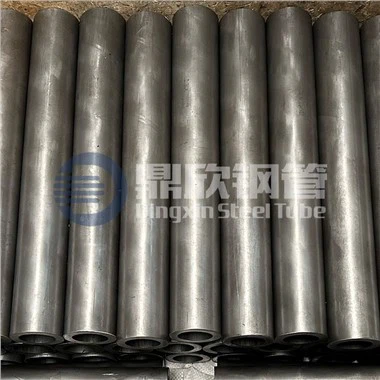
Hey there! I'm a supplier of A519 tubing, and I often get asked about how to calculate the flow rate in A519 tubing. So, I thought I'd write this blog post to share some insights on this topic.
First off, let's understand what A519 tubing is. A519 tubing is a type of seamless mechanical tubing that meets the ASTM A519 standard. It's commonly used in various applications, especially in the automotive industry. We offer a wide range of A519 tubing products, like ASTM A519 SAE AISI 4130 4140 QT Seamless Tubing, Cold Drawn Seamless Carbon Steel Tube 10# 20# 35# 45# 55#, and Alloy Seamless Tube 20CrMo 30CrMo 35CrMo 42CrMo For Automotive Parts. These tubes are known for their high quality and durability.
Now, let's dive into the flow rate calculation. The flow rate in a tube refers to the volume of fluid that passes through the tube per unit of time. There are a few factors that affect the flow rate in A519 tubing, and we need to consider them when making the calculation.
Factors Affecting Flow Rate
- Tube Diameter: The diameter of the A519 tubing plays a crucial role. A larger diameter generally allows for a higher flow rate because there's more space for the fluid to pass through. Think of it like a highway - a wider highway can handle more cars at once.
- Fluid Viscosity: Viscosity is a measure of a fluid's resistance to flow. For example, honey is more viscous than water. A more viscous fluid will flow more slowly through the tubing, resulting in a lower flow rate.
- Pressure Difference: The difference in pressure between the two ends of the tube is what drives the fluid to flow. A greater pressure difference will typically lead to a higher flow rate. It's like pushing a ball harder; it'll roll faster.
Calculating the Flow Rate
There are a few methods to calculate the flow rate in A519 tubing, and one of the most common is using the Hagen - Poiseuille equation. This equation is applicable for laminar flow (a smooth, orderly flow) of a Newtonian fluid (a fluid with constant viscosity) through a cylindrical tube.
The Hagen - Poiseuille equation is given by:
[Q=\frac{\pi r^{4}\Delta P}{8\mu L}]
Where:
- (Q) is the volumetric flow rate (in (m^{3}/s))
- (r) is the radius of the tube (in meters)
- (\Delta P) is the pressure difference between the two ends of the tube (in Pa)
- (\mu) is the dynamic viscosity of the fluid (in (Pa\cdot s))
- (L) is the length of the tube (in meters)
Let's break down the steps to use this equation:
- Measure the Tube Dimensions: First, you need to measure the radius ((r)) and the length ((L)) of the A519 tubing accurately. Make sure to use the same unit system throughout the calculation, usually the SI system.
- Determine the Pressure Difference: Use a pressure gauge to measure the pressure at the inlet and the outlet of the tube, and then calculate the difference ((\Delta P)).
- Find the Fluid Viscosity: You can look up the viscosity of the fluid in reference tables. For common fluids like water at different temperatures, there are well - established values.
- Plug the Values into the Equation: Once you have all the values, substitute them into the Hagen - Poiseuille equation to calculate the flow rate.
However, it's important to note that the Hagen - Poiseuille equation has its limitations. It only works for laminar flow. In real - world situations, the flow may be turbulent, especially at high flow velocities or in tubes with rough inner surfaces.
For turbulent flow, we can use the Darcy - Weisbach equation. The Darcy - Weisbach equation is more complex and takes into account the friction factor ((f)) which depends on the Reynolds number ((Re)) and the roughness of the tube wall.
The Darcy - Weisbach equation for flow rate is:
[Q = A\sqrt{\frac{2gD\Delta P}{fL}}]
Where:
- (A) is the cross - sectional area of the tube ((A=\pi r^{2}))
- (g) is the acceleration due to gravity ((9.81m/s^{2}))
- (D) is the diameter of the tube
- (f) is the friction factor
- (\Delta P) is the pressure difference
- (L) is the length of the tube
To use the Darcy - Weisbach equation, you first need to calculate the Reynolds number ((Re)) using the formula:


[Re=\frac{\rho vD}{\mu}]
Where:
- (\rho) is the density of the fluid
- (v) is the average velocity of the fluid
- (D) is the tube diameter
- (\mu) is the dynamic viscosity of the fluid
The Reynolds number helps us determine whether the flow is laminar ((Re<2000)), turbulent ((Re > 4000)), or in a transition zone ((2000<Re<4000)).
Practical Considerations
When calculating the flow rate in A519 tubing in real - world applications, there are a few practical things to keep in mind:
- Tube Wall Roughness: The inner surface of the A519 tubing may not be perfectly smooth. A rougher surface can increase the friction and reduce the flow rate. Our A519 tubing is manufactured to have a relatively smooth inner surface, which helps to minimize this effect.
- Temperature Changes: Temperature can affect both the fluid viscosity and the tube dimensions. For example, as the temperature increases, the viscosity of most fluids decreases, which can increase the flow rate.
- Fittings and Bends: Any fittings, valves, or bends in the tubing system can cause additional pressure drops and affect the flow rate. You may need to account for these losses in your calculations.
Importance of Accurate Flow Rate Calculation
Accurately calculating the flow rate in A519 tubing is crucial in many applications. In the automotive industry, for example, proper flow rate control is essential for the cooling system, fuel delivery system, and hydraulic systems. If the flow rate is too low, the system may not function properly, leading to overheating or inefficient operation. On the other hand, if the flow rate is too high, it can cause excessive wear and tear on the components and may even lead to system failures.
As a supplier of A519 tubing, we understand the importance of providing our customers with high - quality products that meet their specific requirements. Whether you need tubing for a high - flow application or a low - flow, precision - controlled system, we can offer the right A519 tubing solution.
Conclusion
Calculating the flow rate in A519 tubing involves considering multiple factors such as tube diameter, fluid viscosity, and pressure difference. We can use equations like the Hagen - Poiseuille equation for laminar flow and the Darcy - Weisbach equation for turbulent flow. However, we also need to take into account practical factors like tube wall roughness, temperature changes, and fittings in the tubing system.
If you're in the market for A519 tubing and need help with flow rate calculations or have any other questions about our products, feel free to reach out. We're here to assist you in finding the best tubing solution for your application. Contact us for more information and to start a procurement discussion.
References
- White, F. M. (2016). Fluid Mechanics. McGraw - Hill Education.
- Cengel, Y. A., & Cimbala, J. M. (2014). Fluid Mechanics: Fundamentals and Applications. McGraw - Hill Education.