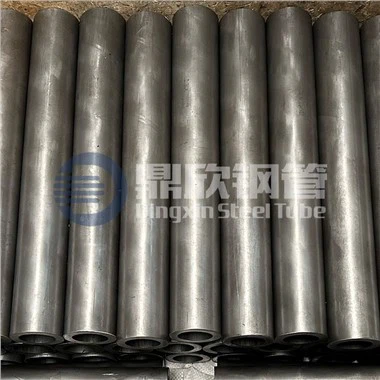
Hey there! I'm a supplier of honed tubes, and I'm super excited to share with you how these awesome honed tubes are made.
Starting with the Raw Material
First things first, we need the right raw material. Usually, we use high - quality steel. It's like the foundation of a house; if the foundation is weak, the whole thing falls apart. The type of steel we choose depends on what the honed tube is going to be used for. For example, if it's for a hydraulic cylinder, we might go for steels like ST45, ST52, 1026, E255, E355, 20#, 45#, 25Mn, Q345B, or 27SiMn. You can check out more about Honed Tube for Hydrulic Cylinder ST45 ST52 1026 E255 E355 20# 45# 25Mn Q345B 27SiMn. These steels have different properties, like strength and hardness, which are crucial for the performance of the final honed tube.
Making the Seamless Tube
Once we've got the steel, the next step is to make a seamless tube. This is done through a process called extrusion or piercing. In extrusion, the steel is heated up until it's really soft, like warm butter. Then, it's forced through a die to create a tube shape. Piercing is a bit different. A hot steel billet is pushed onto a mandrel, which is like a rod, and as it moves forward, a hole is created in the center, forming a tube. This seamless tube is important because it doesn't have any weak points along the seam, which could cause problems later on.
Initial Machining
After we have the seamless tube, it goes through some initial machining. We cut the tube to the right length. This is super important because the honed tube needs to be the exact size for its intended use. Then, we might do some rough machining on the outer and inner surfaces. This helps to remove any rough edges or uneven parts from the tube. It's like giving the tube a quick once - over to make sure it's in good shape before we start the more precise work.
The Honing Process
Now, here's the main event: the honing process. Honing is what gives the tube its smooth inner surface. We use a honing tool, which has abrasive stones on it. The honing tool is inserted into the tube, and it rotates and moves back and forth. As it does this, the abrasive stones grind away at the inner surface of the tube, removing a very thin layer of material. This process is very precise, and we can control the size and finish of the inner surface. We can make the surface as smooth as we need it to be, which is crucial for things like hydraulic cylinders. In a hydraulic cylinder, a smooth inner surface helps the piston move smoothly, reducing friction and wear.


The honing process also helps to improve the roundness and straightness of the tube. If the tube is not perfectly round or straight, it can cause problems in the hydraulic system. So, honing makes sure that the tube meets the high - quality standards required for these applications.
Heat Treatment
Sometimes, after honing, the tube goes through heat treatment. Heat treatment is like giving the tube a strength boost. We heat the tube to a specific temperature and then cool it down at a controlled rate. This changes the structure of the steel, making it stronger and more durable. There are different types of heat treatment, like annealing, quenching, and tempering. The type we choose depends on the type of steel and the requirements of the final product.
Final Inspection
Once all the processes are done, the honed tube goes through a final inspection. We check the dimensions to make sure they are within the specified tolerance. We also look at the surface finish to ensure it's smooth and free of any defects. We might use special tools like calipers and micrometers to measure the size accurately, and we'll use visual inspection or even non - destructive testing methods to check for any internal defects. Only when the tube passes all these inspections can it be considered a high - quality honed tube.
Quality Control
Quality control is a big part of our work. We have strict quality control measures in place at every step of the manufacturing process. From the raw material selection to the final inspection, we make sure that everything is done right. We keep records of all the processes and inspections, so if there are any issues later on, we can trace back and find out what went wrong.
Applications of Honed Tubes
Honed tubes are used in a wide range of applications. One of the most common uses is in hydraulic cylinders. In hydraulic systems, the honed tube provides a smooth surface for the piston to move, allowing for efficient operation. They are also used in pneumatic cylinders, where compressed air is used instead of hydraulic fluid. Additionally, honed tubes can be found in construction equipment, automotive parts, and industrial machinery.
For example, if you're looking for a specific type of honed tube for hydraulic cylinders, you might be interested in ASTM A519 1026 Hydraulic Cylinder Tube or ASTM A519 1026 Honed Tube. These tubes are made to meet specific standards, which ensures their quality and performance in different applications.
Why Choose Our Honed Tubes
As a supplier, we take pride in the quality of our honed tubes. We have a team of experienced professionals who know how to make high - quality honed tubes. We use the latest technology and equipment to ensure that our products are top - notch. We also offer a wide range of sizes and materials to meet the different needs of our customers. Whether you need a small - sized honed tube for a precision application or a large - sized one for heavy - duty machinery, we've got you covered.
If you're in the market for honed tubes, we'd love to talk to you. We can provide you with more information about our products, answer any questions you might have, and work with you to find the right honed tube for your application. Just reach out to us, and we'll start the conversation about how we can meet your honed tube needs.
References
- "Manufacturing Processes for Engineering Materials" by Serope Kalpakjian and Steven R. Schmid
- "Hydraulic and Pneumatic Systems" by Peter B. Nachtwey