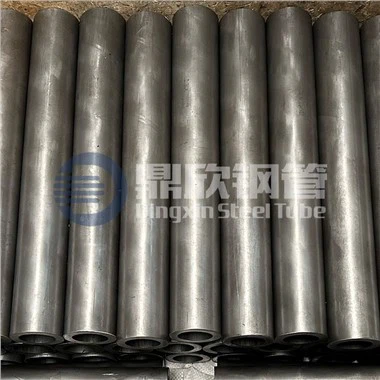
Hey there! As a supplier of E235 +N, I often get asked about the thermal properties of this material. So, I thought I'd write this blog post to share some insights.
First off, let's understand what E235 +N is. E235 is a type of mild steel, and the “+N” indicates that it's normalized. Normalizing is a heat treatment process that improves the material's mechanical properties by heating it above its critical temperature and then air - cooling it.
Thermal Conductivity
The thermal conductivity of E235 +N is an important property, especially in applications where heat transfer is involved. Generally, mild steels like E235 +N have a thermal conductivity in the range of about 45 - 50 W/(m·K) at room temperature. This means that it can conduct heat relatively well compared to some other materials.
For example, if you're using E235 +N in a heat exchanger, this thermal conductivity allows for efficient transfer of heat from one fluid to another. The heat moves through the steel wall of the exchanger, from the hot fluid side to the cold fluid side. However, compared to metals like copper or aluminum, which have much higher thermal conductivities (copper has around 400 W/(m·K)), E235 +N is not as effective in rapid heat transfer. But in many industrial applications, its thermal conductivity is just right.
Specific Heat Capacity
The specific heat capacity of E235 +N is another crucial thermal property. Specific heat capacity is the amount of heat energy required to raise the temperature of a unit mass of a substance by one degree Celsius. For E235 +N, the specific heat capacity is approximately 460 J/(kg·K).
This value implies that it takes 460 joules of energy to increase the temperature of one kilogram of E235 +N by one degree Celsius. In practical terms, if you're heating a large mass of E235 +N in a furnace, you need to supply a significant amount of heat energy because of its specific heat capacity. On the flip side, when it comes to cooling, the material will also release a fair amount of heat energy as it cools down.
Thermal Expansion
Thermal expansion is a property that describes how a material changes in size when its temperature changes. E235 +N has a coefficient of linear thermal expansion of about 11 - 12 × 10⁻⁶ /K. This means that for every one - degree Celsius increase in temperature, a one - meter long piece of E235 +N will expand by about 11 - 12 micrometers.
In applications where precise dimensions are critical, this thermal expansion needs to be taken into account. For instance, in a machine where E235 +N components are used, if there's a significant temperature change during operation, the expansion or contraction of the material can affect the fit and performance of the machine. Engineers often design systems with expansion joints or allowances to accommodate this thermal expansion.
Applications Based on Thermal Properties
The thermal properties of E235 +N make it suitable for a variety of applications. In the construction industry, it's used in structural components. The relatively good thermal conductivity helps in dissipating heat in case of a fire, and the specific heat capacity allows the structure to absorb a certain amount of heat energy without rapidly reaching high temperatures.
In the automotive industry, E235 +N can be used in various parts. For example, it can be used in engine components where heat transfer and the ability to withstand temperature changes are important. You can also check out our 1026 Seamless Tubing and JIS G 3445 STKM 11 A STKM 12 B STKM 13 C STKM 14 B Tube for more automotive - related options. And if you're looking for steel tubes for automotive parts with different properties, our EN10083 - 3 34Crmo4 42Crmo4 +C +QT Steel Tube for Automotive Part might be of interest.
Impact of Heat Treatment on Thermal Properties
As mentioned earlier, E235 +N is normalized. Normalizing can have a minor impact on its thermal properties. The heat treatment process aligns the grain structure of the steel, which can slightly improve its thermal conductivity and other properties. However, the overall change is not extremely significant compared to the base properties of the mild steel. Other heat treatment processes like quenching and tempering can have more pronounced effects on the mechanical and thermal properties, but they're not typically associated with E235 +N.
Comparison with Other Materials
When compared to stainless steels, E235 +N generally has a higher thermal conductivity. Stainless steels often have lower thermal conductivities due to the presence of alloying elements like chromium and nickel, which disrupt the flow of heat through the material. On the other hand, compared to non - metallic materials like ceramics, E235 +N is much better at conducting heat. Ceramics usually have very low thermal conductivities and high specific heat capacities.
Maintaining Thermal Properties
To ensure that the thermal properties of E235 +N remain consistent, proper storage and handling are essential. Exposure to moisture and corrosive environments can cause rusting, which can affect the material's thermal conductivity and other properties. Regular inspections and protective coatings can help in maintaining the integrity of the material and its thermal performance.
Conclusion
In conclusion, the thermal properties of E235 +N, including its thermal conductivity, specific heat capacity, and thermal expansion, make it a versatile material for many industrial applications. Whether it's in construction, automotive, or other fields, understanding these properties is crucial for proper design and use.
If you're interested in purchasing E235 +N or have any questions about its thermal properties and how it can fit into your application, feel free to reach out. We're here to assist you in making the right choice for your projects.


References
- “Materials Science and Engineering: An Introduction” by William D. Callister Jr. and David G. Rethwisch
- “ASM Handbook Volume 1: Properties and Selection: Irons, Steels, and High - Performance Alloys”