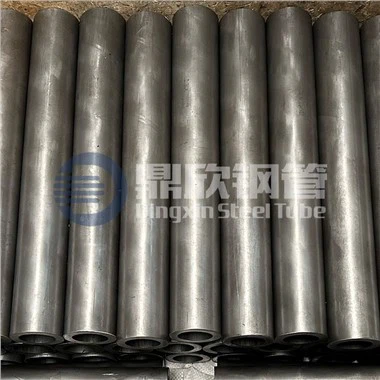
As a reliable supplier of AISI 4140 tubes, I often encounter inquiries about the carburizing process for these tubes. Carburizing is a crucial heat - treatment process that can significantly enhance the properties of AISI 4140 tubes, making them suitable for a wide range of applications. In this blog, I will delve into what the carburizing process for AISI 4140 tubes entails, its benefits, and how it impacts the performance of the tubes.
Understanding AISI 4140 Tubes
Before we explore the carburizing process, let's briefly understand AISI 4140 tubes. AISI 4140 is a chromium - molybdenum alloy steel. It is known for its high strength, good toughness, and excellent hardenability. These tubes are widely used in automotive, aerospace, and machinery industries for applications such as shafts, gears, and axles. Our company offers a variety of AISI 4140 tubes, and you can also check out other related products like [ASTM A519 SAE AISI 1010 1020 1026 1045 1541 4130 4140 Mechanical Tubing](/automotive - tube/astm - a519 - sae - aisi - 1010 - 1020 - 1026 - 1045 - 1541.html), [Cold Drawn Seamless Tube Q345B Q345D Q355B Q355D](/automotive - tube/cold - drawn - seamless - tube - q345b - q345d - q355b.html), and [ASTM A519 SAE AISI 4130 4140 QT Seamless Tubing](/automotive - tube/astm - a519 - sae - aisi - 4130 - 4140 - qt - seamless.html).
What is Carburizing?
Carburizing is a thermochemical process in which carbon is diffused into the surface layer of a metal, typically low - carbon or medium - carbon steels like AISI 4140. The goal is to increase the carbon content of the surface while maintaining a relatively lower carbon content in the core. This creates a hard, wear - resistant outer layer and a tough, ductile core, combining the best of both worlds in terms of material properties.
The Carburizing Process for AISI 4140 Tubes
1. Preparation
Before the carburizing process begins, the AISI 4140 tubes need to be thoroughly cleaned. Any dirt, oil, or scale on the surface can interfere with the carbon diffusion process. The tubes are usually degreased and pickled to ensure a clean surface. After cleaning, the tubes may be masked in areas where carburizing is not desired. This can be done using special masking compounds or copper plating.
2. Loading into the Furnace
The cleaned and masked AISI 4140 tubes are then loaded into a carburizing furnace. The furnace can be of different types, such as gas carburizing furnaces, pack carburizing furnaces, or plasma carburizing furnaces. Each type has its own advantages and is suitable for different production requirements.
3. Carburizing Stage
- Gas Carburizing: In gas carburizing, the tubes are heated in an atmosphere rich in carbon - containing gases, such as methane (CH₄) or propane (C₃H₈). At high temperatures (usually between 850°C - 950°C), these gases decompose, releasing carbon atoms. The carbon atoms diffuse into the surface of the AISI 4140 tubes. The process is carefully controlled by adjusting the gas flow rate, temperature, and time. The longer the tubes are exposed to the carburizing atmosphere, the deeper the carbon diffusion will be.
- Pack Carburizing: Pack carburizing involves packing the AISI 4140 tubes in a container filled with a carbon - rich material, such as charcoal or bone meal. The container is then sealed and heated in a furnace. Similar to gas carburizing, carbon atoms are released from the packing material and diffuse into the tube surface. Pack carburizing is a relatively simple and cost - effective method, but it may not provide as uniform a carburized layer as gas carburizing.
- Plasma Carburizing: Plasma carburizing is a more advanced method. In this process, the tubes are placed in a low - pressure chamber filled with a carbon - containing gas. An electric field is applied to create a plasma, which activates the carbon atoms and accelerates their diffusion into the tube surface. Plasma carburizing can achieve a more precise control of the carburized layer thickness and carbon concentration.
4. Quenching
After the carburizing stage, the tubes are rapidly cooled, or quenched. Quenching is a critical step as it transforms the high - carbon surface layer into a hard martensitic structure. The choice of quenching medium depends on the specific requirements of the tubes. Common quenching media include oil, water, and polymer solutions. Oil quenching is often preferred for AISI 4140 tubes as it provides a good balance between cooling rate and the risk of cracking.
5. Tempering
Quenching can introduce high internal stresses in the tubes, which may lead to cracking or distortion. To relieve these stresses and improve the toughness of the carburized layer, the tubes are tempered. Tempering involves heating the tubes to a temperature below the critical point (usually between 150°C - 650°C) and holding them at that temperature for a certain period of time. The exact tempering temperature and time depend on the desired properties of the tubes.
Benefits of Carburizing AISI 4140 Tubes
- Improved Wear Resistance: The hard carburized surface layer significantly enhances the wear resistance of the AISI 4140 tubes. This makes them ideal for applications where the tubes are subject to friction and abrasion, such as in gears and bearings.
- Increased Surface Hardness: Carburizing can increase the surface hardness of AISI 4140 tubes to levels much higher than the base material. This allows the tubes to withstand higher loads and pressures without deformation.
- Enhanced Fatigue Resistance: The combination of a hard surface layer and a tough core improves the fatigue resistance of the tubes. They can better withstand cyclic loading, reducing the risk of fatigue failure.
- Retained Toughness in the Core: While the surface is hardened, the core of the AISI 4140 tubes retains its toughness. This means that the tubes can still absorb energy and resist cracking under impact loads.
Applications of Carburized AISI 4140 Tubes
Carburized AISI 4140 tubes are used in a wide range of industries. In the automotive industry, they are used for drive shafts, transmission gears, and differential components. In the aerospace industry, these tubes are used in aircraft landing gear components and engine parts. In the machinery industry, they are used for conveyor rollers, machine tool spindles, and other high - stress components.

Quality Control in the Carburizing Process
To ensure the quality of carburized AISI 4140 tubes, strict quality control measures are implemented throughout the process. This includes monitoring the furnace temperature, gas flow rate, and time during the carburizing stage. After the process, the tubes are inspected for surface hardness, carbon concentration, and case depth. Non - destructive testing methods, such as ultrasonic testing and magnetic particle testing, can be used to detect any internal defects.

Conclusion
The carburizing process is a powerful tool for enhancing the properties of AISI 4140 tubes. By creating a hard, wear - resistant surface layer and a tough core, carburized AISI 4140 tubes can meet the demanding requirements of various industries. As a supplier of AISI 4140 tubes, we are committed to providing high - quality products with excellent carburizing treatment. If you are interested in purchasing AISI 4140 tubes or have any questions about the carburizing process, please feel free to contact us for a detailed discussion and negotiation.
References
- ASM Handbook, Volume 4: Heat Treating, ASM International
- Metals Handbook Desk Edition, ASM International
- "Fundamentals of Heat Treatment of Steels" by L. C. Zhang and Y. F. Zhang