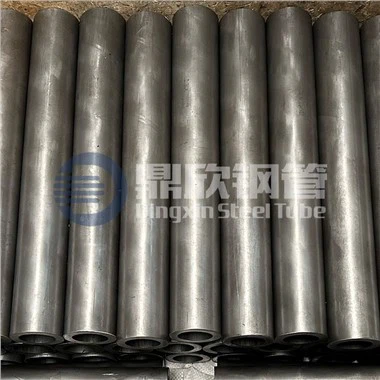
Hey there! As a supplier of ST35 NBK, I often get asked about what sets it apart from other similar steels. So, in this blog, I'm gonna break down the differences and give you a better understanding of why ST35 NBK might be the right choice for your projects.


Chemical Composition
Let's start with the chemical composition. ST35 NBK is a non - alloy structural steel. It has a relatively low carbon content, usually around 0.17 - 0.24%. This low carbon content gives it some unique properties. For example, it's quite ductile, which means it can be easily formed into different shapes without cracking.
When we compare it with DIN2391 ST52 NBK Seamless Tube, ST52 NBK has a higher carbon content and also contains some alloying elements like manganese. These alloying elements increase its strength and hardness. So, if you need a steel that can withstand high stress and load, ST52 NBK might be a better option. But if you're looking for something that can be bent, rolled, or welded easily, ST35 NBK is the way to go.
Another comparison can be made with ASTM A519 SAE AISI 1010 1020 1026 1045 1541 4130 4140 Mechanical Tubing. The AISI series steels have a wide range of carbon contents. For instance, AISI 1010 has a very low carbon content (around 0.08 - 0.13%), which makes it even more ductile than ST35 NBK but also less strong. On the other hand, AISI 1045 has a higher carbon content (around 0.43 - 0.50%), resulting in higher strength but lower ductility compared to ST35 NBK.
Mechanical Properties
In terms of mechanical properties, ST35 NBK has a good balance between strength and ductility. Its yield strength is typically around 235 - 275 MPa, and its tensile strength is in the range of 370 - 500 MPa. This makes it suitable for a variety of applications where moderate strength is required.
Take DIN 17200 C22/Ck22 C25/Ck25 C30/Ck30 C35/Ck35 C45/Ck45 C55/Ck55 Seamless Tube for example. The C - series steels in this standard have different carbon contents, which directly affect their mechanical properties. As the carbon content increases from C22 to C55, the strength and hardness of the steel also increase, but the ductility decreases. So, if you need a part that requires high - strength and can tolerate less deformation, you might choose a higher - carbon steel from this series. But if you need a part that can be formed and still maintain a certain level of strength, ST35 NBK is more appropriate.
Heat Treatment Response
ST35 NBK doesn't respond as dramatically to heat treatment as some other steels. Since it has a low carbon content, heat treatment processes like quenching and tempering won't significantly increase its strength. It can be normalized to improve its grain structure and mechanical properties slightly, but the overall change is not as pronounced as in steels with higher carbon or alloying element contents.
In contrast, the AISI 4130 and 4140 steels from the ASTM A519 series are alloy steels. They respond very well to heat treatment. By quenching and tempering, their strength and hardness can be increased significantly, making them suitable for applications where high - strength and good wear resistance are required, such as in the automotive and aerospace industries.
Weldability
One of the big advantages of ST35 NBK is its excellent weldability. Because of its low carbon content, it can be welded easily using common welding methods like arc welding, gas welding, and resistance welding. There's less risk of cracking during the welding process, and the welded joints usually have good mechanical properties.
Some of the higher - carbon steels and alloy steels, like the ones in the DIN 17200 C - series with higher carbon content or the alloy steels in the ASTM A519 series, may require pre - heating and post - welding heat treatment to ensure good weld quality and prevent cracking. This adds to the complexity and cost of the manufacturing process.
Cost
Cost is always an important factor in any project. ST35 NBK is generally more cost - effective compared to some of the alloy steels and higher - carbon steels. Since it doesn't contain expensive alloying elements and is relatively easy to produce, its price is more budget - friendly. This makes it a popular choice for applications where cost is a major concern, such as in general engineering and construction projects.
Applications
ST35 NBK is widely used in many industries. It's commonly used for manufacturing pipes, tubes, and profiles. In the automotive industry, it can be used for making parts like brackets, frames, and some non - critical components. In the construction industry, it can be used for structural elements where moderate strength is sufficient.
The other steels we've mentioned have their own specific applications. For example, DIN2391 ST52 NBK is often used in applications where higher strength is required, such as in heavy - duty machinery and construction equipment. The ASTM A519 series steels are used in a wide range of mechanical applications, from automotive engines to aerospace components, depending on their specific properties.
Conclusion
So, as you can see, ST35 NBK has its own unique characteristics that set it apart from other similar steels. Its low carbon content gives it good ductility and weldability, and it's also cost - effective. While other steels may have advantages in terms of higher strength or better heat - treatment response, ST35 NBK is a great choice for many applications where a balance of properties and cost is needed.
If you're interested in purchasing ST35 NBK for your projects, I'd love to have a chat with you. Let's discuss your specific requirements and see how ST35 NBK can meet your needs. Whether it's for a small - scale project or a large - scale industrial application, I'm here to help you make the right choice.
References
- "Steel Handbook: Properties and Selection: Irons, Steels, and High - Performance Alloys"
- "Mechanical Metallurgy"
- Technical data sheets of ST35 NBK, DIN2391 ST52 NBK, ASTM A519 series, and DIN 17200 series steels.